
Asset visibility asks a simple question: “Where is the object?”
This is a great start for modern factories, warehouses, hospitals, airports, and logistics centers. A tool may be visible on the map, a pallet may appear in the system, and a vehicle may be shown in real time. Moving towards a better question though, is whether that asset is in the right place, at the right stage, following the right process.
Real Time Locating Systems (RTLS) provide continuous location data for assets, vehicles, equipment, and people within a defined environment. Depending on the use case, different technologies can be applied. UWB supports high precision positioning, especially in industrial environments where centimeter level accuracy is required. BLE Angle of Arrival can support precise indoor tracking by estimating the angle from which Bluetooth signals arrive at anchors. BLE beacons are useful for room level visibility and proximity based workflows. RFID can identify items at defined scanning points. GPS and RTK extend visibility outdoors. LoRaWAN can support long range communication for selected IoT scenarios.
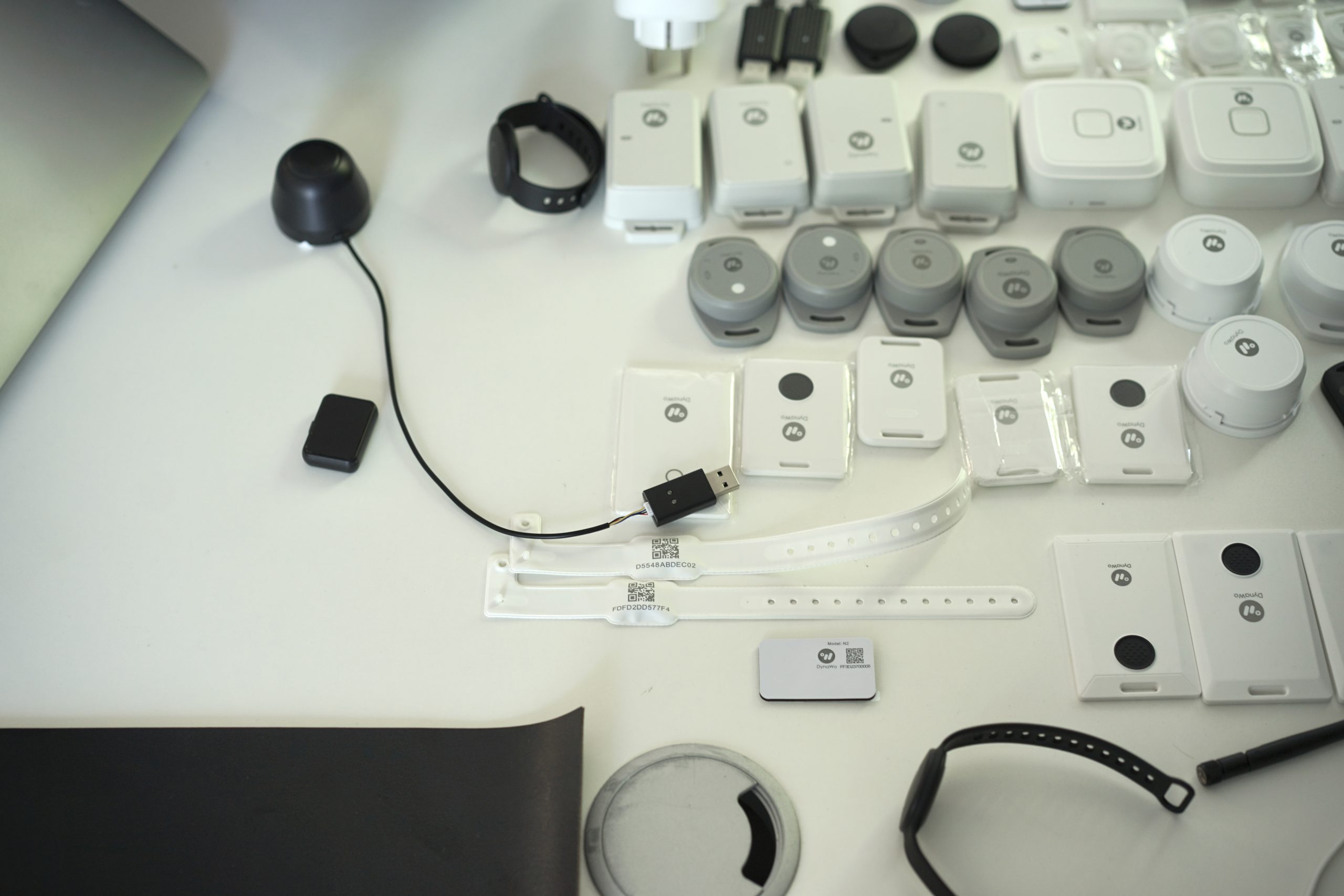
DynaWo’s portfolio is built around this hybrid logic, combining technologies according to the operational environment rather than forcing one technology onto every problem.
A torque tool in an automotive or aviation assembly line has an assigned task, a calibration status, a permitted work area, and a relationship to a specific product or production stage. A container in pharmaceutical production follows a controlled sequence of storage, processing, inspection, quarantine, and release. A maintenance vehicle in a warehouse has a defined inspection route, with required checkpoints and time intervals.
Indoor positioning formalizes these expectations in motion. Geofences define production cells, storage zones, certified rooms, dispatch areas, inspection routes, safety regions, and restricted areas. Middleware consolidates location data from different technologies and provides standardized location information for business applications. When spatial models are connected to workflow status, the system can detect operational misalignment.
Misalignment can take several forms. An asset may enter the wrong zone. A tool may remain outside its storage area after use. A pallet may be staged for dispatch before the order is ready. A container may bypass a required quality control area. An inspection vehicle may miss a checkpoint. A forklift may spend too much time on a route that should be shorter. These cases form small deviations that remain invisible until they accumulate into delays, search time, quality risks, or safety problems.
RTLS makes these deviations measurable in three layers.
- One layer is spatial congruence. This means checking whether the asset identity, physical location, and process stage match each other. A calibrated tool belongs only in certain work areas. A high value device may belong in a certified room. A medical asset may need to remain within a defined department. A material batch may need to follow a specific sequence. When the asset appears in a location that does not match its assigned workflow, the system can register the inconsistency immediately.
- A second layer is movement topology. Over time, the movement of assets create patterns: common routes, corridor density, transition points, dwell zones, and bottlenecks. RTLS data can reveal whether material handling routes are longer than expected, whether assets accumulate in certain corridors, whether elevators create delays in multi level buildings, or whether staging zones become overloaded at specific times of day. Historical path analysis, heatmaps, charts, reports, process status, and 2D real time overview can turn raw movement data into practical operational insight.
- A third layer is behavioural baseline analysis. After enough data has been collected, the system can define what normal movement looks like for different asset classes. A maintenance cart may have a typical service loop. A forklift may usually follow predictable routes between storage and production. A tool may normally return to storage within a defined time window. When dwell time increases, route variability changes, or assets cluster in unusual areas, the system can indicate a process issue before it becomes a formal incident.
The technical design and selection of product lines depend on your needs. A strong RTLS concept starts with the workflow, then selects the right locating technologies.
UWB is often selected where high precision and frequent updates are needed, such as tool tracking, vehicle tracking, production line visibility, or safety zones. BLE Angle of Arrival can be effective where scalable indoor positioning is required and the environment supports anchor based angle estimation. RFID is useful for identification at scanning points, especially when direct continuous tracking of every low cost item would be unnecessary or too expensive. GPS and RTK support outdoor movement, yard management, transport visibility, and supply chain scenarios.
DynaWo’s strength is the ability to combine these layers into a scenario specific system. Hardware provides the signal. The location engine calculates position. Middleware standardizes the data. The data platform turns movement into reports, heatmaps, historical paths, process status, and operational insight. Business systems such as WMS, MES, ERP, or inspection platforms can then use location data to trigger actions, document compliance, and improve planning.
Asset visibility therefore becomes a way to understand whether the physical operation matches the digital process. It shows where assets are, where they should be, how they moved, where delays occur, and where the workflow is beginning to drift. In environments where efficiency, safety, traceability, and compliance depend on movement, this is the real value of indoor positioning.
With the right RTLS architecture, facilities can move from reactive searching to measurable process control. They can reduce manual search time, detect wrong handling earlier, improve asset utilization, support audit trails, and redesign workflows based on real movement data.
The result is a facility that sees its assets clearly and understands how those assets behave.