
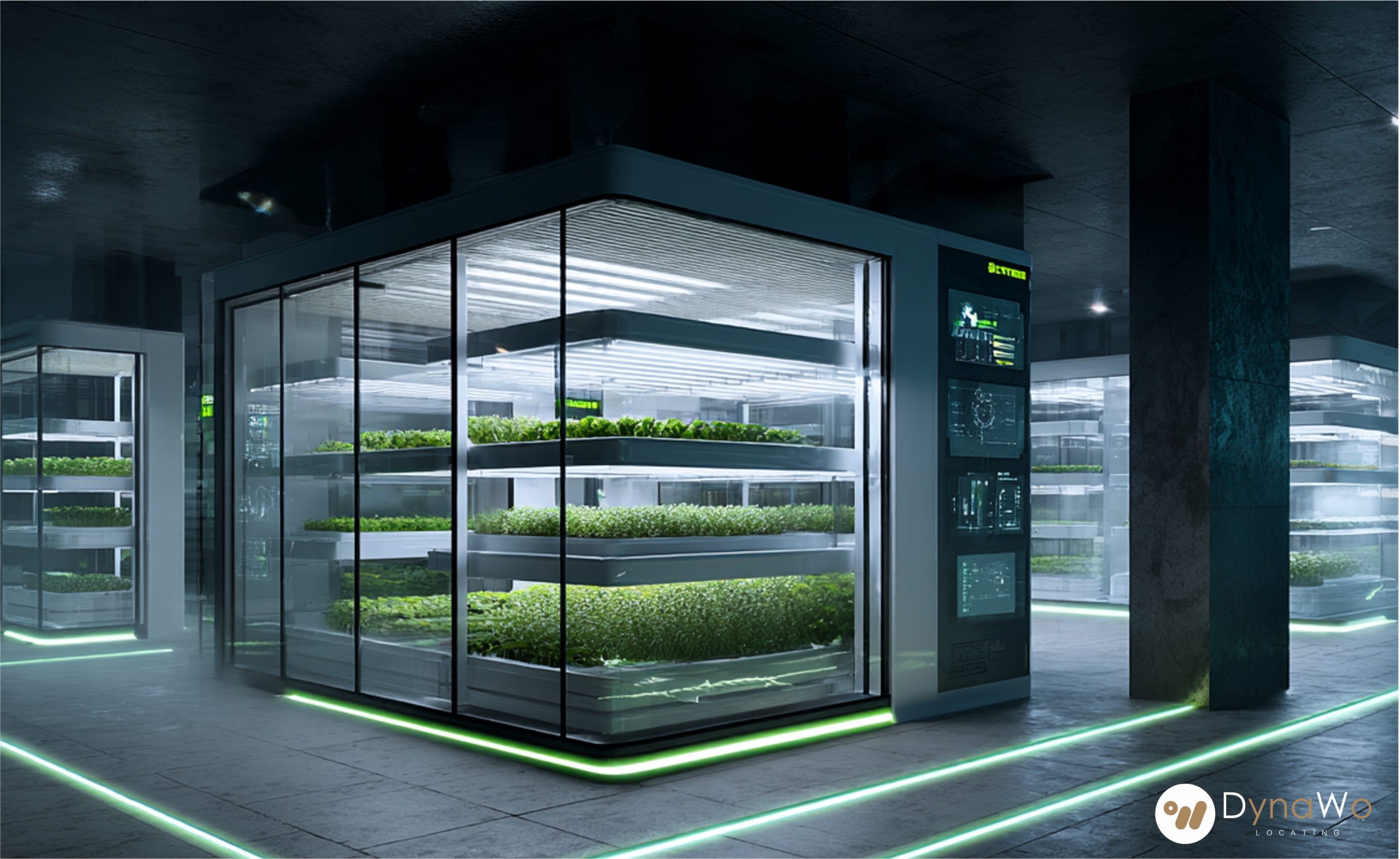
Indoor vertical farms are designed around control, yet growers still deal with uneven outcomes. One rack performs well while another of the same crop under the same nominal settings grows more slowly, holds moisture longer, or shows earlier signs of stress. The reason may often be an accumulation of small environmental differences across rows, heights, corners, and work routines. In this article, we provide reasons why vertical farming needs microclimate intelligence more than conventional locating.
Most growers will benefit from having clearer evidence about where warmer air collects, where humidity lingers, how airflow changes after maintenance, and which crop zones are repeatedly exposed to conditions outside the target range. A practical approach starts with sensor enabled BLE devices placed on representative racks, mobile inspection carts, or sampling points across different tiers. These devices can monitor temperature, humidity, and carbon dioxide and send data through BLE gateways to a central platform. Because the sensors move with the rack or are deliberately distributed across the growing area, operators get a far more realistic picture than they would from a few fixed wall mounted probes alone.
Installing RTLS thus changes how problems are diagnosed in the following ways:
- A repeated humidity spike on one upper tier may point to weak air circulation.
- A cooler band near one end of the room may reveal an HVAC imbalance.
- A pattern of delayed drying after irrigation may show that a specific layout is trapping moisture.
RTLS enables growers to connect plant performance to measurable environmental patterns and adjust fan placement, rack spacing, irrigation timing, or workflow accordingly.
The historical record matters as much as the live dashboard. When racks are moved for cleaning, harvesting, or reconfiguration, their environmental exposure history stays visible. Over time, farms can compare crop performance against the actual conditions experienced in each zone rather than against nominal set points alone. That supports tighter process control, earlier detection of mould risk, and more confident decisions about layout changes.
Indoor agriculture succeeds when consistency moves from assumption to evidence. For vertical farms, the real opportunity is provided by RTLS through building a better environmental picture of the growing space and use that picture to improve crop uniformity, reduce waste, and refine the conditions that plants experience every day.