
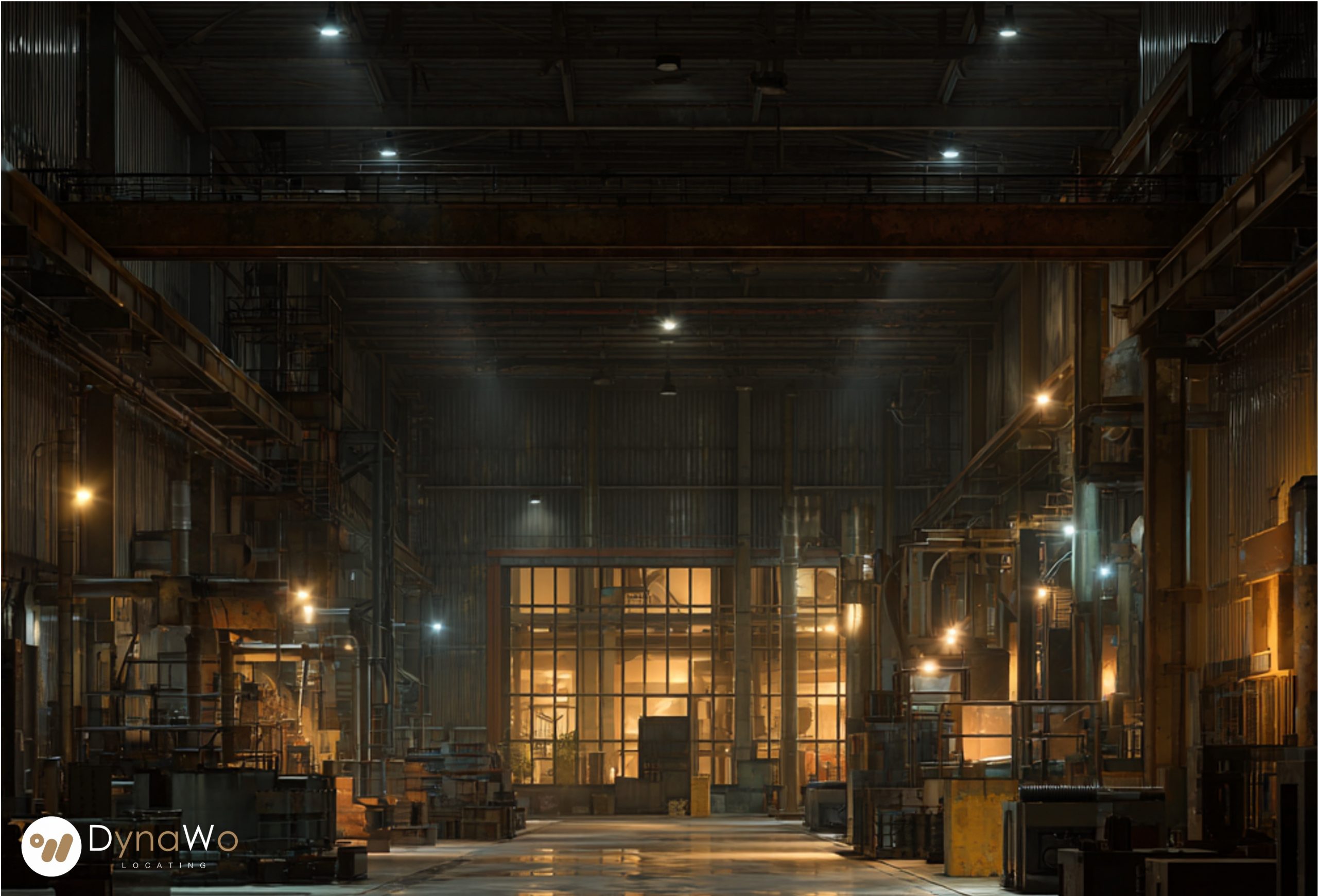
Facilities operate very differently when the lights go down. During after-hours periods, staff density drops, movement slows, and workflows shift from production to preparation, creating a unique operational challenge. A building that is full of motion during the day becomes sparse, quiet, and dependent on automated systems at night. Yet this low-visibility environment often hides inefficiencies: Equipment left running, HVAC zones conditioning empty spaces, delayed replenishment work, unbalanced cleaning cycles, and slow recovery from unplanned disruptions.
RTLS provides that sought after spatial intelligence to manage these dark-facility hours with accuracy and stability.
Bluetooth Low Energy (BLE) and Ultra-Wideband (UWB) form the basis of this intelligence. BLE provides broad coverage and energy-efficient tracking of equipment, carts, and working capacity. UWB adds precision where movement must be controlled in tight or hazardous zones. Both technologies act as continuous sensors of occupancy and activity patterns. Anchors distributed through the facility capture real-time location updates and feed them to the RTLS middleware, which interprets how the environment behaves when staffing falls to a minimum.
One of the most impactful applications is targeted energy orchestration. Traditional building management systems operate on static schedules: Lights off at a certain hour, HVAC reduced at another, ventilation lowered during non-peak periods. But real buildings do not behave in neat time blocks. With RTLS, energy can be controlled dynamically. The system identifies unoccupied zones and automatically adjusts lighting, HVAC, and airflow based on real-time absence rather than assumptions. Equipment racks, server rooms, cold storage, and material staging areas can all be conditioned according to actual demand, preventing both under-conditioning and unnecessary energy expenditure.
Dark-facility operations also rely on precision equipment management. Tags on tools, cleaning machines, inspection carts, or maintenance kits allow teams to verify that equipment is returned to base locations, charged, or staged for the next shift. Precise tracking systems help track mobile assets that must navigate hazard-prone or low-light areas, ensuring movements remain safe and correctly sequenced.
Maintenance becomes more efficient when spatial data reveals inconsistent behaviour. RTLS can detect when tasks take longer than expected, when autonomous vehicles deviate from planned routes, or when replenishment patterns diverge from historical norms. These anomalies often signal early-stage issues—equipment degradation, misplaced assets, or route obstructions. By addressing them in the low-traffic hours, operators prevent interruptions during peak time. Security gains another dimension in the dark facility. RTLS can monitor after-hours movement for compliance with restricted areas. Geofences define where late-night presence is expected and where it is not. If a tag enters a high-value storage zone or approaches sensitive machinery unexpectedly, the system alerts security teams immediately. This discrete spatial layer supplements existing badge systems without requiring intrusive monitoring. Perhaps the most overlooked benefit is morning readiness. In many operations, the first shift begins by resolving unknowns from the night before: locating misplaced equipment, clearing obstructions, verifying conditions, or recovering delayed tasks. With RTLS-driven logs, supervisors can review after-hours movements, confirm completion of essential activities, and adjust work schedules before the day begins. The facility starts aligned, not uncertain.
The lack of human presence in an after-hours facility also benefits from orchestrated awareness. RTLS provides that awareness through continuous, reliable spatial data. It becomes the quiet conductor of night operations, ensuring the building remains efficient, balanced, and ready for the next day.