
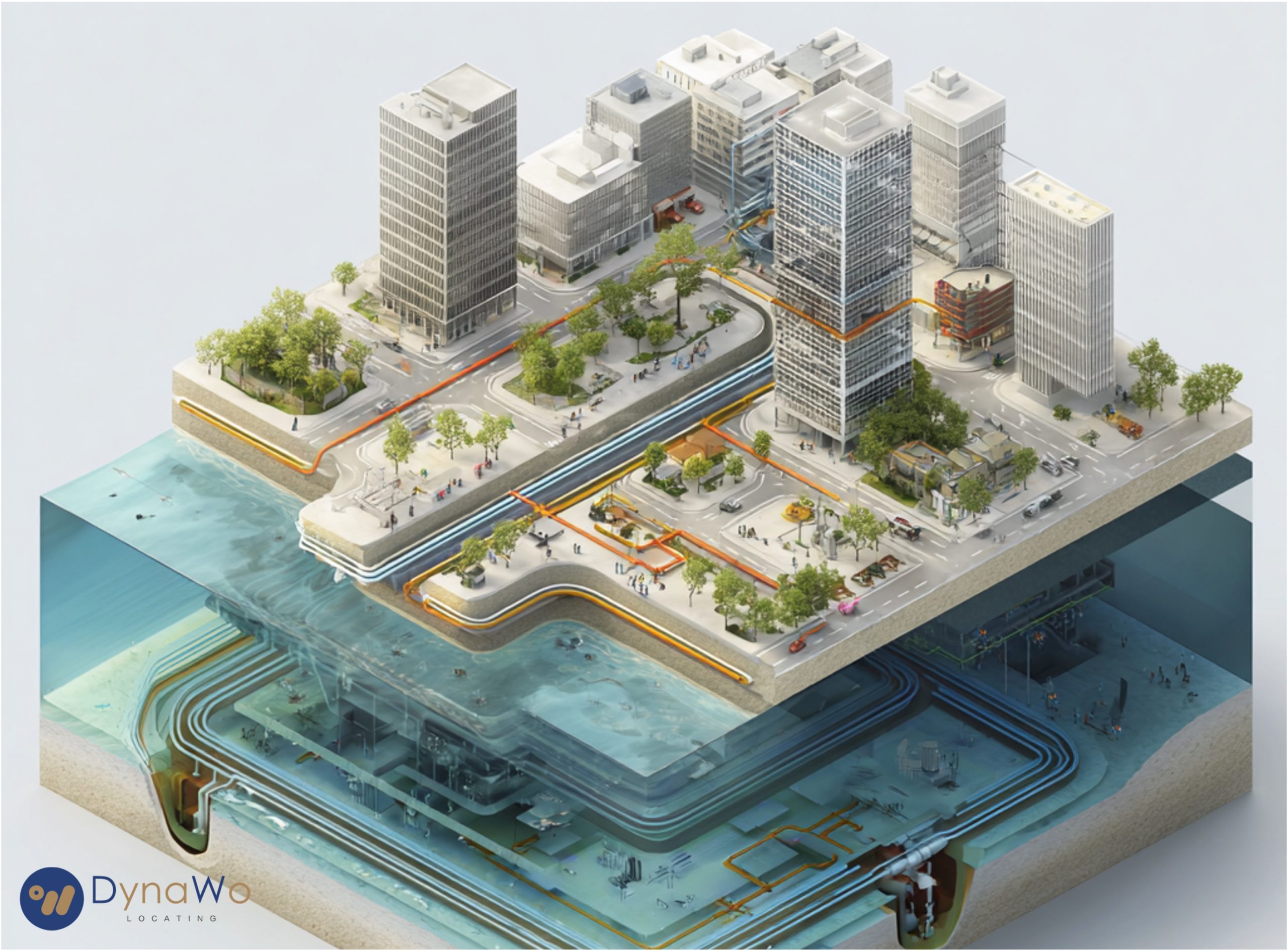
Every city depends on water. It moves quietly beneath the streets, flowing through pipes and channels, supplying life where it is needed. People rarely see the system that makes it possible, but it shapes every moment of the city’s rhythm. A factory supported by RTLS behaves in much the same way. Beneath every smooth workflow is an invisible flow of data, carried across layers that keep operations coherent and alive. This architecture can be understood through the logic of a water system. There is the source, where raw data is gathered. There are the channels that organize and transport that data. And then there are the experiences people see and feel at the surface. Together, these layers form the digital infrastructure that allows modern factories to act like living cities.
At the foundation of every RTLS deployment is the location engine. This is the reservoir — the origin of clarity and precision. But unlike a single water source, factories may rely on multiple RTLS technologies, each producing its own flow of information:
• UWB engines deliver high accuracy for fast-moving assets
• BLE engines provide cost-effective presence and movement data
• LoRaWAN engines offer long-range environmental readings
• RFID engines record checkpoints through proximity events
Each technology has its own computational “spring,” its own way of converting signals into coordinates, timestamps, or condition data. These engines operate simultaneously, each producing a stream tailored to a specific need. Individually, these streams are powerful. Together, they are transformative. But streams alone do not create a city. They need structure.
This is where middleware enters — the system of pipes, channels, and valves that guide the flow. Middleware receives the outputs of every location engine and organizes them into a single, coherent current. It standardizes formats, applies rules, and transports information where it needs to go. Much like a city’s water network prevents flooding or contamination, middleware ensures data moves with stability and purpose. It blends multiple technologies into one dependable river of insight. Without this layer, every data stream would run independently, creating confusion. With it, the factory becomes an integrated whole.
Finally, there is the surface — the part humans see. The application layer presents the organized flow of information as clear, actionable tools. This layer is the city life above the streets. The fountains, the taps, the irrigation, the daily experience. The user never sees the pipes or the reservoirs, but they feel the effect: information that arrives at the right moment, in the right place, in the right form. Applications transform invisible infrastructure into something intuitive and valuable.
When these three layers work together — the water source, the channels, and the visible experience — the factory gains a natural sense of order. Movement becomes coordinated. Information reaches the right hands without friction. Operators navigate their environment with ease. Machines and workflows align with quiet precision. Like a well-run city, a well-designed RTLS system does not call attention to its complexity. It simply lets everything flow.