
When most people talk about the benefits of real-time location systems (RTLS), the conversation goes straight to efficiency and cost. Fewer search times. Less wasted labor. Reduced errors. Those benefits are real. But there’s another angle that often goes unnoticed—one that’s becoming more important every year: sustainability.
Around the world, industry is under pressure to go green. The EU’s Green Deal sets ambitious climate targets, Germany’s Supply Chain Act requires companies to track environmental and social impacts, and customers themselves expect businesses to cut waste. Going digital is a big part of that. And that’s where RTLS can make a difference.
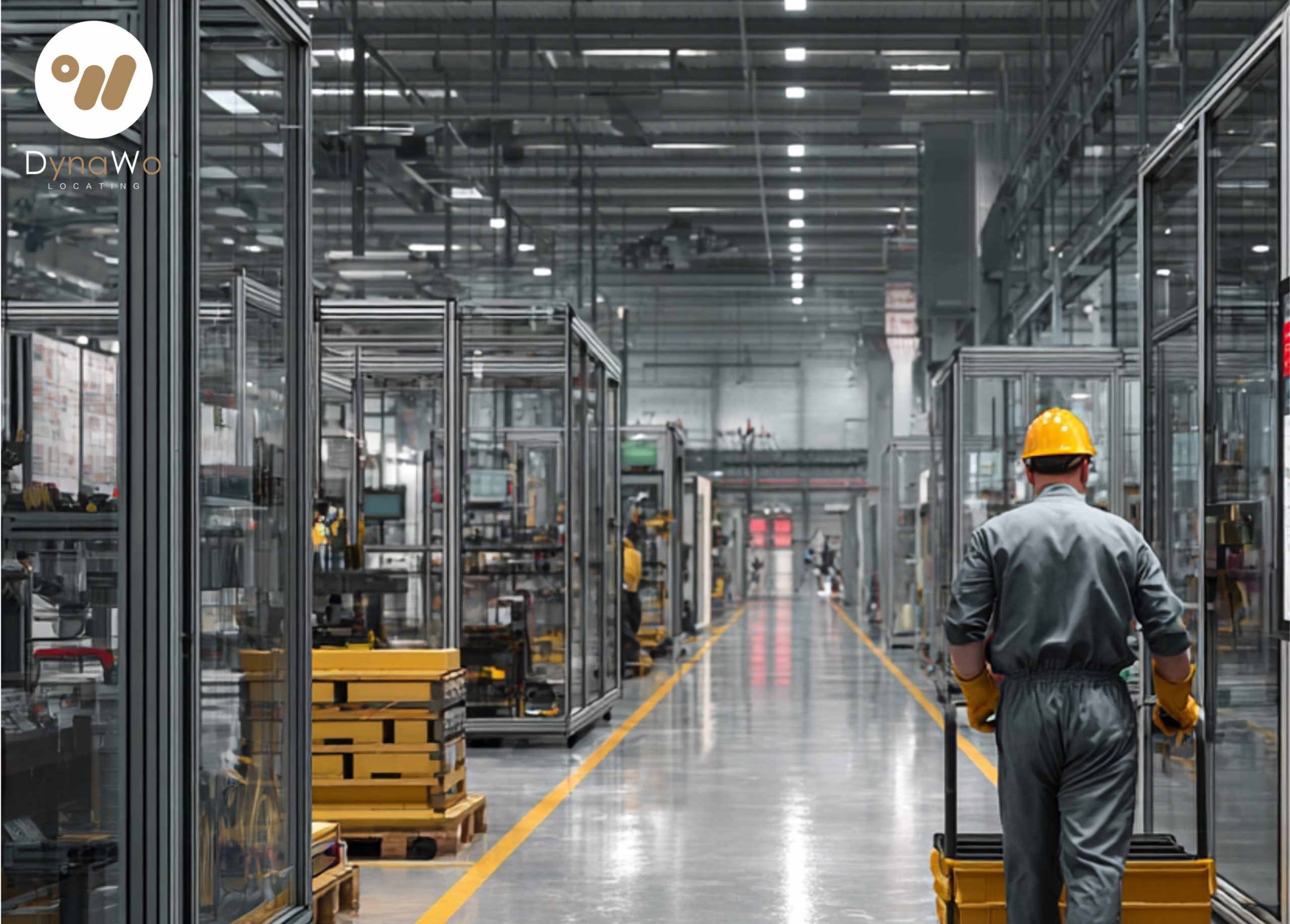
Consider a typical production line. Workers move important assets from one step to the next: Step 1 complete, Step 2 in progress, Step 3 ready for inspection. On paper, literally, that usually means signing a form, ticking a box, or scanning a printed QR code. But in reality? It doesn’t always happen. Workers wear gloves. They are focused on keeping production moving. Stopping to sign or scan slows everything down. So the paperwork is often delayed, or missed altogether. By the time the data is entered, the product may already be finished. The line has moved on, but the records lag behind.
This is precisely where RTLS changes the game. Instead of requiring workers to stop, remove gloves, and document each step, tags on assets move with them. Anchors along the production line record the progress automatically. The moment a tagged item enters Station 1, the system knows. When it passes through Station 3, that’s logged too. No paperwork. No manual scanning. No delays.
For the business, the benefits are obvious: real-time visibility, no gaps in reporting, and smoother flow of materials. But the hidden benefit is just as powerful: no more paper forms. Every manual checklist, every printed QR sheet, every signed handoff becomes unnecessary. What was once a binder of forms is now live digital data.
A mid-sized factory in Germany adopting a paperless and carbon-neutral strategy can make a significant environmental and operational impact. By digitizing documentation and workflow processes, the factory could save 10 pieces of paper per process per day across 10 orders, eliminating the use of 100 sheets daily—equivalent to over 25,000 sheets annually. Since producing one sheet of paper emits about 5 grams of CO₂, this shift could reduce emissions by roughly 125 kilograms of CO₂ each year. Beyond cutting paper costs and storage needs, this also reduces deforestation, energy consumption, and waste. When combined with renewable energy sources, efficient machinery, and digital communication systems, the factory moves closer to becoming carbon neutral. It’s easy to forget that sustainability isn’t just about solar panels on the roof or switching to electric trucks. It’s also about the small systemic wastes—like unnecessary paper—that add up across thousands of shifts and millions of products. RTLS helps eliminate those wastes at the root, by turning physical movements into digital signals.
Workers no longer juggling clipboards and gloves. Operations not only become faster, but cleaner.
At DynaWo, we’ve always said RTLS is about more than tags and anchors. It’s about making environments smarter and people’s work easier. But it’s also about making operations greener. Going paperless may not be the first reason a factory invests in RTLS. But it might just be one of the most important reasons they stay.
European Commission. (2019). The European Green Deal. Retrieved from https://ec.europa.eu/green-deal
German Federal Ministry for Economic Affairs and Climate Action. (2021). Supply Chain Due Diligence Act. Retrieved from https://www.bmwk.de/