
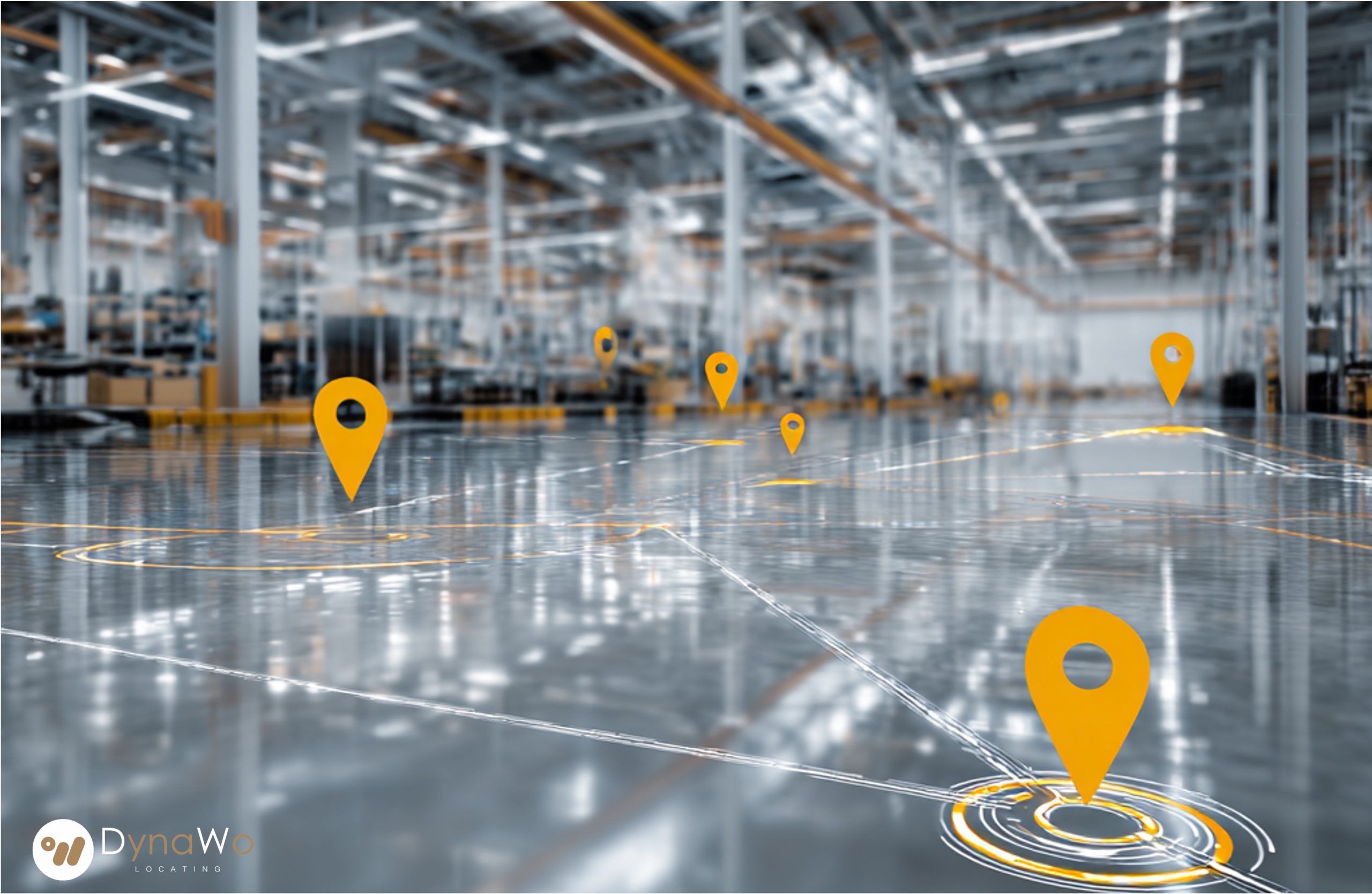
Digital twins were once understood as virtual replicas of individual machines. These early twins focused on mechanical behaviour, vibration patterns, wear curves, and predicted failure cycles. But as industries moved toward system-level optimisation, the limitations became clear: machines do not operate in isolation. They interact with people, materials, environments, and time.
A modern digital twin is a living representation of an entire operational ecosystem, with RTLS sitting at the very foundation of this evolution. A facility-wide digital twin requires three forms of information:
- Where things are
- How they move
- What conditions surround them
RTLS provides the first two, while environmental sensors complete the third. By combining UWB’s high-precision coordinates, BLE AoA’s zone-level awareness, Wi-Fi RTT measurements, and inertial motion data, an RTLS engine builds a spatial understanding of every moving entity inside a facility. Unlike static models, this data updates continuously and creates a digitalized twin from this real-time spatial layer.
Quick example: Imagine an assembly line looking perfectly balanced on paper, but in reality we find pallets consistently accumulating in certain corners, always slowing production. These micro-frictions form the reality of the process. With RTLS, they become visible and trackable in real-time, which makes them solvable.
RTLS also enables temporal fidelity. Each movement becomes a time-stamped event, allowing the twin to replay workflow behaviour, identify patterns by shift or zone, and understand the cadence of operations. With this temporal dimension, the digital twin becomes predictive. If historical data shows that congestion forms near a sorting lane every afternoon, the system can forecast it and propose interventions.
A facility-wide digital twin driven by RTLS also supports dynamic simulation. Rather than assuming ideal conditions, it simulates operations using real input: AGV routing delays, equipment dwell times, asset cycles, and environmental fluctuations. This allows companies to test layouts, staffing models, automation deployments, and maintenance schedules with high realism.
The integration is straightforward. The RTLS middleware provides an API that streams location events, zone transitions, and environmental readings. The digital twin ingests this feed, resolves it into operational models, and outputs predictions or optimisation paths. Another example: Imagine twin may detecting tools that are consistently stored too far from the stations that use them, indicating a layout imbalance or material-flow issue.
Environmental mapping adds further precision. Temperature, humidity, vibration, air quality, and equipment-load data reveal how conditions interact with movement. A digital twin is able to correlate temperature spikes with slower AGV performance or increased equipment drift. It can detect when airflow patterns affect worker comfort and reduce productivity.
The value of such a twin extends beyond efficiency. It becomes an engine for resilience. When disruptions occur, such as a machine failure, a personnel shortage, or an unexpected spike in demand, the digital twin helps operators simulate recovery paths and reroute work intelligently. RTLS elevates digital twins from static replicas to responsive, behavioural systems. It connects the physical and digital worlds with accuracy, speed, and context. In doing so, it brings the future of operational intelligence.