
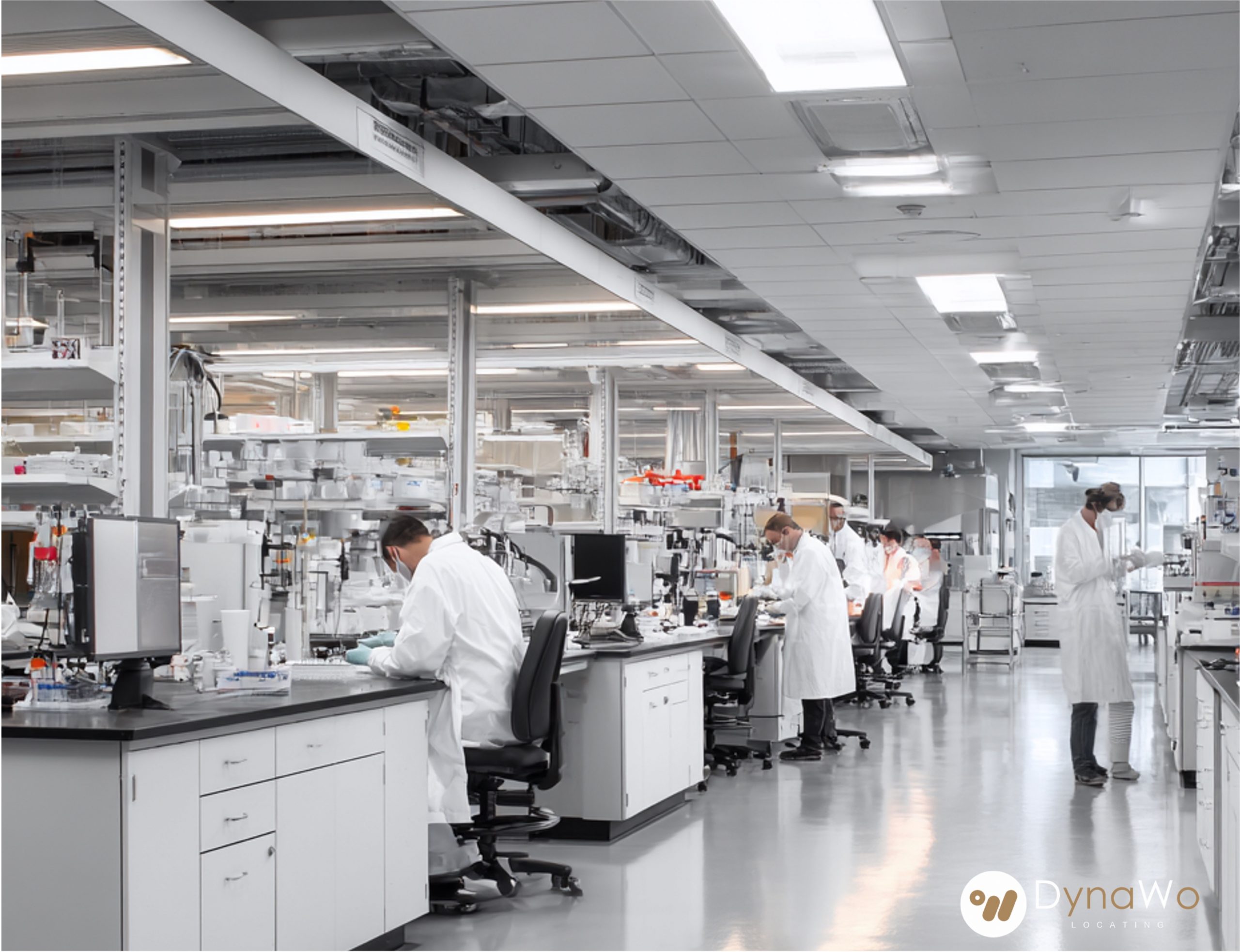
A laboratory is a world built on layers of precision. Beneath the visible orchestration of instruments and researchers lies an intricate universe of micro-scale reactions, calibrated temperatures, controlled humidity, and movements measured in seconds. Yet even in these highly structured environments, the paths that samples take, the exact positions of shared instruments, and the subtle environmental shifts that influence experimental outcomes often remain unobserved. Laboratories depend on accuracy in every dimension, but their internal motion traditionally relies on memory, discipline, and manual documentation.
RTLS introduces a form of spatial precision that mirrors the scientific rigor of the laboratory itself. Tags placed on reagents, sample trays, cryoboxes, mobile instruments, and even waste containers broadcast signals through ultra-wideband, Bluetooth Low Energy, or hybrid radio platforms. Anchors set across the lab — on ceilings, instrument racks, cold rooms, and incubator corridors — capture these signals and determine position using multilateration, angle-of-arrival geometry, or calibrated signal profiling. Every movement becomes part of a spatial dataset as exacting as the instruments that populate the benches.
This is particularly transformative for the chain-of-custody of samples. A sample’s history is often as important as its composition. RTLS records when it leaves the freezer, how long it remains at ambient temperature, which technician handled it, how quickly it reaches an instrument, and whether it follows approved routing through sterile or non-sterile zones. The middleware constructs a continuous audit trail without interrupting workflow, ensuring compliance with regulatory frameworks while reducing the cognitive load on researchers.
Environmental sensing adds another layer of precision. Tags equipped with temperature or humidity sensors travel with materials that are sensitive to microclimate fluctuations. As they move between rooms, fume hoods, incubators, and biosafety cabinets, they record a fine-grained environmental map that reveals patterns otherwise impossible to detect. A single reagent drifting one degree beyond optimal range may produce inconsistent data; RTLS identifies the exact moment and location of such deviation, allowing researchers to intervene before the experiment is compromised.
Instrumentation logistics also gain clarity. Shared equipment frequently move between stations. RTLS locates them instantly, reducing downtime and preventing loss in large multi-room facilities. Through geofencing, the system enforces boundaries so that instruments remain in their intended zones, alerting staff if a device is removed without authorization or relocated to an environment unsuitable for its calibration stability.
The resilience of RTLS lies in its layered architecture. Even if line-of-sight is limited by incubators or dense metal structures, anchor diversity ensures redundancy. Sensor fusion stabilizes location data by integrating inertial measurements from tags, smoothing motion paths when radio signals weaken. Middleware continuously reconciles these inputs into coherent spatial intelligence, giving laboratories a dependable perspective even under complex physical constraints.
A laboratory is defined by the pursuit of certainty. RTLS extends that pursuit from the level of molecules to the level of movement, creating an environment where each action becomes measurable, each deviation becomes visible, and each step in a workflow becomes part of an unbroken chain of precision.