
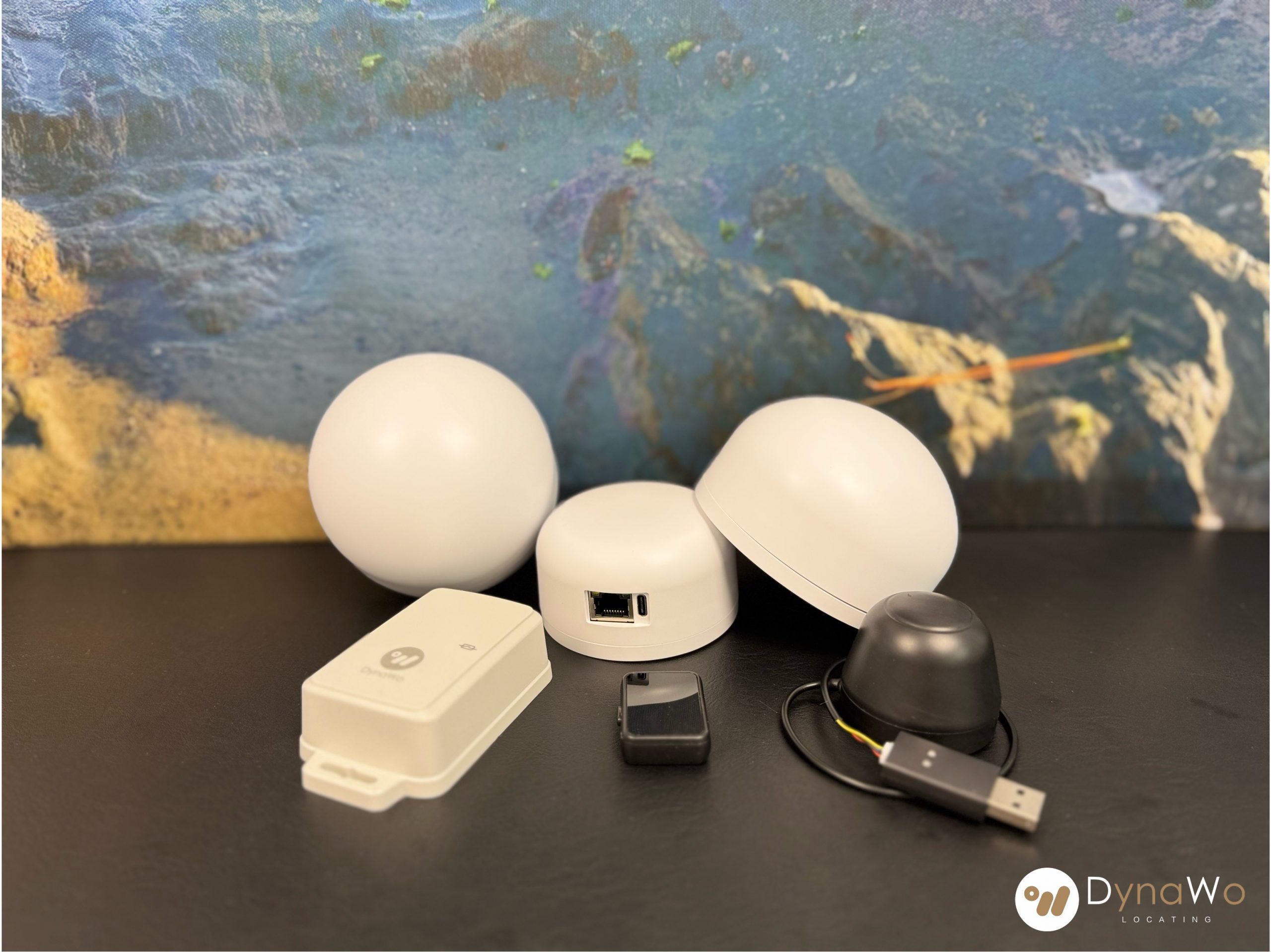
Ultra-wideband (UWB) is widely regarded as one of the most accurate indoor positioning technologies available. It transmits extremely short pulses across a wide frequency spectrum, enabling precise measurement of signal travel time between tags and anchors. Unlike technologies that infer distance from signal strength, UWB uses time-of-flight (ToF) and time-difference-of-arrival (TDoA) calculations, producing consistent sub-30-centimeter accuracy even in dense industrial environments.
UWB anchors typically require line-of-sight for optimal results, but the technology is resilient to multipath reflections due to the characteristics of its pulse-based waveform and short wavelength. Each anchor timestamps incoming pulses with nanosecond precision. When several anchors observe the same tag, the system determines its coordinates by solving geometric relationships between measured time differences. This allows UWB to maintain accuracy in metal-heavy environments such as factories, warehouses, and production lines.
UWB tags support higher update rates than most radio-based RTLS approaches. Position updates between 10 and 100 times per second are common, enabling real-time tracking of forklifts, mobile robots, fast-moving components on production lines, and safety-critical worker monitoring. Tags can also incorporate sensors—temperature, acceleration, environmental data—whose readings are transmitted alongside location information.
Infrastructure planning is essential for UWB deployments. Anchors must be positioned to maintain clear geometric orientation, and networks typically run synchronised timing to maintain TDoA accuracy. This structure results in highly stable tracking, but requires well-planned installation compared with more flexible technologies such as BLE.
Modern UWB systems increasingly support hybrid modes, where TDoA is used for continuous tracking and two-way-ranging (TWR) is used for verification or fallback. TWR enables anchors and tags to exchange timing information directly, providing robust accuracy when anchor visibility is limited.
UWB’s strengths make it a standard choice for industrial automation, collision avoidance, predictive maintenance routing, and digital twin implementations. It excels where precision and reliability are mandatory, even at higher infrastructure cost.
DynaWo’s expertise exists as a solution provider, to listen to your concerns and your aims in order to best utilize the right technology for you. If this means UWB for you, then let’s get in touch to find out how!