
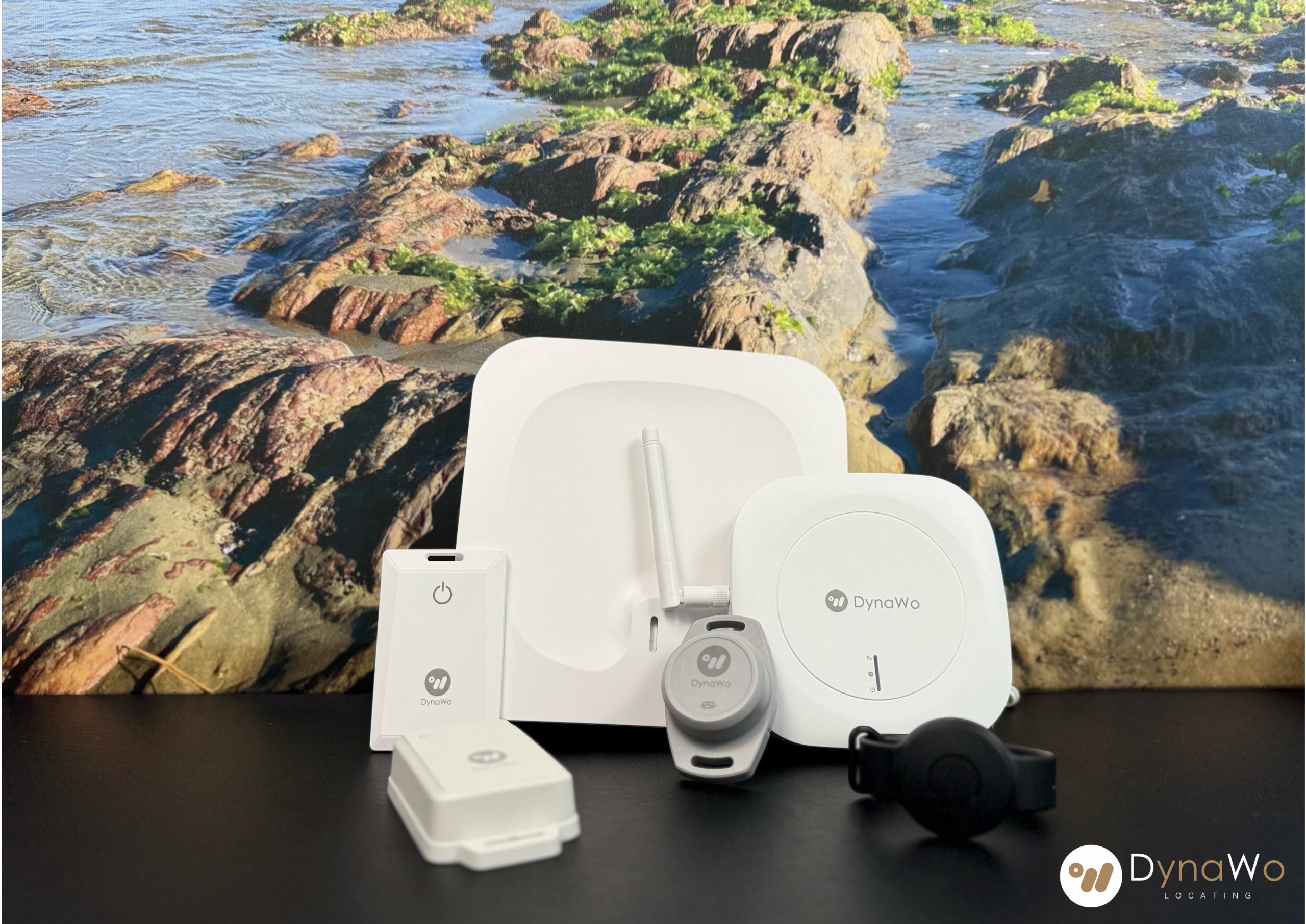
Bluetooth-based RTLS has become a central technology in indoor positioning because it combines cost efficiency, interoperability, and continuously improving accuracy. Among these approaches, Bluetooth Angle of Arrival (AoA) represents the most significant advancement. It uses antenna arrays to determine the direction from which a tag’s signal reaches the anchor, enabling location accuracy that moves from general proximity detection toward precise coordinate-level results.
Bluetooth AoA works by equipping anchors with antenna arrays capable of switching rapidly between elements. As a Bluetooth Low Energy (BLE) tag transmits, the anchor measures the phase differences across antennas and calculates a signal arrival angle. When several anchors observe the same tag, the system performs geometric calculations to determine its real-time position, often achieving sub-meter precision in open environments. Because the tag transmits standard BLE signals, tags remain small, power-efficient, and highly cost-effective.
Traditional BLE technologies supported proximity-based RTLS using Received Signal Strength Indicator (RSSI), which remains suitable for room-level or zone-level monitoring. RSSI offers an economical solution for applications that do not require fine-grained tracking. It is widely used for geofencing, entry detection, and basic workflow automation. Bluetooth AoA complements this by providing higher accuracy without sacrificing interoperability.
Another advantage is ecosystem maturity. BLE is supported across nearly all consumer and industrial devices, lowering integration barriers. Anchors communicate through standard IP networks and can be deployed densely or sparsely depending on required precision. This scalability makes Bluetooth attractive for environments such as retail, hospitality, logistics, hospitals, and office buildings where installation restrictions, aesthetics, and cost constraints influence technology choice.
Middleware plays a crucial role in interpreting AoA measurements. Signal fluctuations caused by reflections, body blockage, and environmental dynamics are smoothed using filtering algorithms, Kalman models, and angle calibration routines. When integrated with additional sensor data—accelerometers, temperature sensors, or interaction buttons—Bluetooth tags form part of a broader situational awareness system.
For customers seeking a flexible RTLS solution, Bluetooth technologies offer a reliable path. RSSI-based installations allow fast, low-cost deployment for presence detection. AoA-based systems add finer accuracy for asset location, worker tracking, safety zoning, and workflow analytics. Both run on the same technology family, simplifying upgrades when precision requirements evolve.
Bluetooth AoA is not designed to replace all RTLS modalities, but it is increasingly positioned as a primary technology for indoor environments where accuracy, cost, and scalability must be balanced. With modern AoA hardware and refined signal processing pipelines, Bluetooth RTLS now delivers a level of performance suitable for enterprise-grade applications without demanding specialized devices for end users.
With Dynawo, organizations can turn Bluetooth RTLS into immediate, practical value. Its intuitive solutions makes deploying, managing, and scaling simple—helping teams boost efficiency, enhance safety, and gain clearer visibility across their operations.